




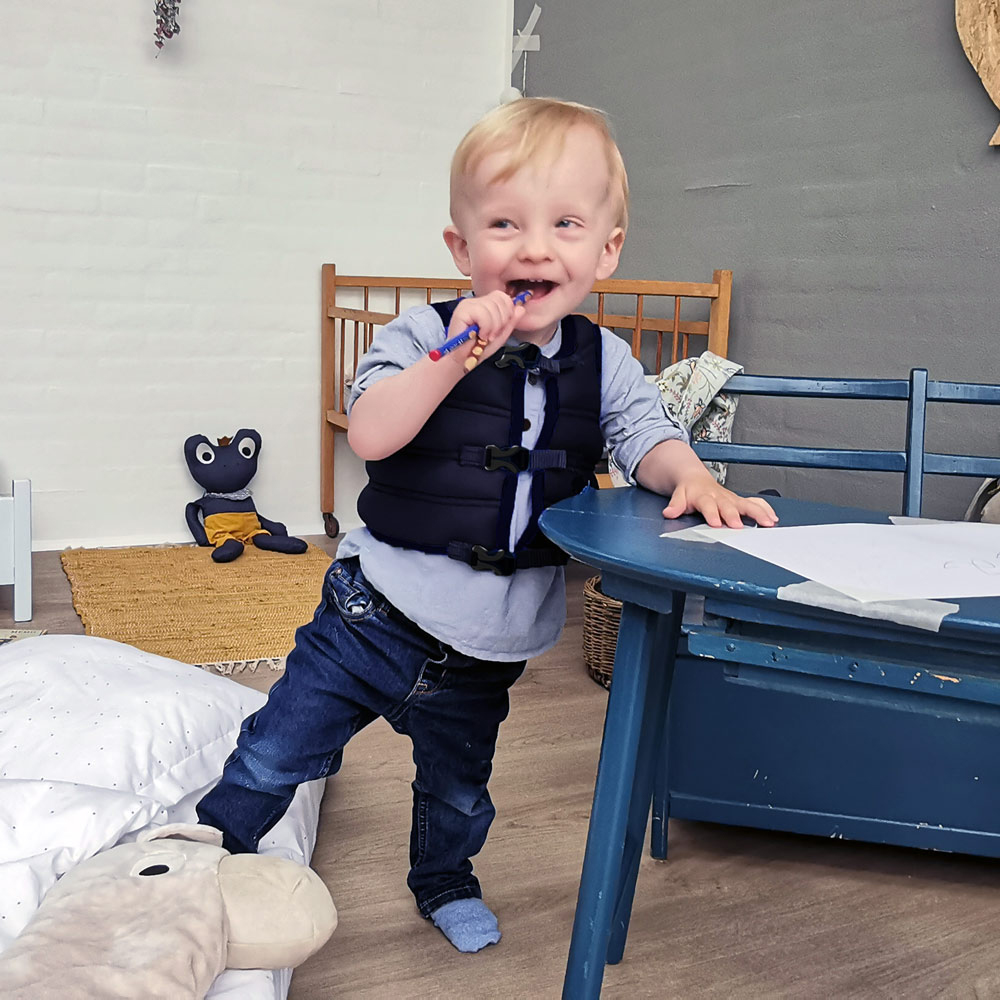
Guide: Implementing sensory strategies in the daycare center over 4 weeks
When sensory strategies work best in a daycare setting, they don’t feel like an extra project. They become a calm, practical way to support children in being in the body, being in community, and being able to participate in play, gathering, meals, and shifts.
In many places, the desired outcome is clear: fewer conflicts, less turmoil, and more moments when children succeed. Sensory strategies can be part of the answer, especially for children with autism., ADHD, Anxiety, sensory processing difficulties or general vulnerability in overstimulating environments. However, the interventions often help the whole group of children when they are used in a simple and consistent way.
What do we mean by sensory strategies in the daycare center?
Sensory strategies are planned interventions that help children regulate arousal, energy, and attention through the body. This can range from small movement breaks to clear, soothing routines, tactile materials, or weight that provides deep relaxation.
The important thing is that the strategies are implemented at times when children typically lose their footing: transitions, dressing, gathering, eating, tidying up, noise times and the afternoon "tired-o's".
A good rule of thumb is to think in two tracks: the environment and the individual. The environment should be bearable, and the child should have a tool when the body starts to make noise.
The senses that move the most in everyday life
When educators talk about "distress in the body," it often refers to senses that cannot be seen but can be felt. Here are three areas that often provide quick results when worked on consciously:
- Proprioception (muscle-joint sense)Weight, push, pull, "heavy work", hugging and deep pressure can create calmness and a sense of boundaries.
- Vestibular sense (balance and movement)Jumping, swinging, turning, and hopping are slow rhythmic movements that can either wake up or calm a child, depending on the tempo and the child.
- Tactile sense (touch)Some children seek touch; others avoid it. Tactile materials, quiet hands, clear boundaries for contact, and "first-touch-then-activity" can support this.
Research and practical experience, among other things conveyed through professional environments such as BUPL, point to sensory motor skills as an important foundation for well-being and participation. In practice, this means that sensory strategies are not "extra" but a layer beneath all pedagogical efforts.
Before you get started: make the plan small enough to succeed
It can be tempting to buy equipment and decorate a sensory room First. Start with structure instead: Who does what, when, and how do we know if it helps?
An implementation over 4 weeks can work well when it has three characteristics: clear accountability, short feedback loops, and a baseline that is easy to record.
Here are a set of basic agreements that often prevent the effort from going to waste:
- Role distribution: one project manager and a small working group with management and educators.
- Common languageWhat do "pause", "overload", "pause" and "withdrawal" mean to you?
- Measuring points: get indicators that are realistic to note in the middle of a busy day.
A simple baseline: what will you be able to see in 4 weeks?
Baseline is not about measuring children. It’s about measuring whether your efforts make the day easier to be in.
After a brief clarifying conversation, you can choose 2 to 4 observations that you note for 10 seconds at a time. Write them down on a common sheet of paper at the board in the classroom or in your documentation system.
- Number of conflicts in the transitions
- Number of times a child leaves the community during a gathering
- Duration of the wardrobe situation from start to finish
- The staff's assessment of "noise level" on a scale from 1 to 5
When the baseline is simple, it’s used. And when it’s used, you can adjust without having to guess.
Four weeks in practice: a realistic course of action that can be followed
Below is an overview that many daycare centers can adapt without having to change their entire daily routine. Think of it as a framework, not a list of facts.
| Week | Focus | What you do in practice | What you follow |
|---|---|---|---|
| 1 | Plan and baseline | Set goals, assign responsibilities, choose 2-4 indicators, observe for 5 weekdays | Starting point before changes |
| 2 | Training and the environment | Common kick-off, mini workshop, adjust sound/zones, establish a calm sensory state | The staff's safety and the children's reactions |
| 3 | Daily use | Tactical strategies into routines, short sensory breaks, testing tools with support | What works when and for whom |
| 4 | Anchoring | Collect experiences, choose "core grip", agree on operation, inform parents | Compare with baseline and decide the next step |
Week 1: Planning, common direction and mindful shopping
Start with a short initial meeting where you agree on a goal in a language that everyone can use. The goal could be: "More relaxed transitions for the whole group" or "More children stay in the group without fighting".
At the same time, you can map out needs through observations: Who gets anxious when what happens? What situations are most demanding? Which adults are the best at handling these situations, and what do they do specifically?
When ordering materials, it may be beneficial to choose a few sturdy items that can withstand Frequent cleaning and everyday use. Oliz/Koko-Nora is working specifically with sensomotoric aids designed for hygienically demanding environments, And this type of quality requirement makes sense in institutional operations, regardless of the supplier.
Week 2: Staff training and small environmental changes that can be felt
A short workshop of 60 to 90 minutes may be enough to get the same result. The focus should not be on theory for the sake of theory, but on concrete approaches: what does a child look like when they are on the way up the alarm? What sensory input can slow down the pace? How do we avoid giving "more of what is already overflowing for the child"?
After the workshop, it makes sense to make some changes in the space. Often it’s about reducing distractions before building up: fewer visual distractions, clearer zones, and a place where breaks are allowed.
It can be a fixed viewing area or a mobile solution where stimuli can be rolled out as needed. Some institutions use a Snoezel trolley or a mobile sensory environment, because it does not require a separate room, and because it can be dosed.
In the same week, you can agree on your "minimum effort": What do we do every day, even when we have a substitute?
Week 3: Implementation, adjustment, and clear routines
Now the strategies need to be put into everyday practice; they should not only be used "when there are problems". Sensory strategies often work best when they are applied just before the difficult times.
You can incorporate them into micro-rituals: 2 minutes of heavy work before assembly, a steady motion path before lunch, or a quiet pressure and a weighted cushion during reading aloud.
When you use heavy products, It is crucial to make it safe and predictable, preferably with professional advice from an ergotherapist or physiotherapist, especially if you work with children with complex needs.
Here is a practical way to keep quality high without making it cumbersome:
- Start gently: short duration, low weight, calm situation.
- Contract signs: What does the child show when he wants more and when he wants to stop?
- Easily document"what, when, effect" in line 1.
Weight can come in many forms: weight vest, seat cushion, shoulder cushion, weight blanket or one sense of touch with weight and tactile input. The Bent series of sensory stimulators is an example of a product that provides deep pressure in a way that some children accept more easily than a vest because it can be placed on the lap or next to the body.
Week 4: Evaluation, parental involvement and long-term sustainability
In the last week, you continue as in week 3, but you start to gather what needs to be carried on. Look at your baseline: Has the number of conflicts changed? Have the transitions become shorter? Are there more children who can stay in the community?
It may be enough with a brief evaluation meeting where you decide your "core actions" for the next 8 to 12 weeks. Choose three things you do every day rather than ten things you do in periods.
Parent collaboration is an important part of the anchoring. Some parents feel more secure when they see the tools and hear that it’s about regulation, not about "fixing" the child. A short informational letter or an open afternoon with small sensory stations can do a lot.
In the conversation with parents, it can help to formulate your questions in a way that invites partnership:
- What we see: the child's pattern in certain situations.
- What we are trying to do: concrete strategies and frameworks.
- What we hope forMore peace, more participation, fewer breakdowns.
Typical barriers and the solutions that often work best
When sensory strategies fail to take hold, it is rarely due to a lack of willpower. It is more about time, effort, and uncertainty: "Are we doing it right?" or "Who is responsible when it burns out?"
A practical way to counter this is to make tools and routines as accessible as plaster and gloves. It should be easy to handle when a child is about to leave the regulation.
Here are three points of operation that many institutions find beneficial to decide in writing:
- Cleaning: who is responsible, when, and where is the instruction located.
- Location: where heavy items and tactile tools are stored so that they can be accessed in 10 seconds.
- Competence: who can introduce strategies to new colleagues and temporary employees.
The last point is often underestimated. When one or two employees become resource persons, the effort becomes less vulnerable to illness and replacement.
When equipment makes sense, and when it doesn't
Therapeutic tools are not magic, and they should not get in the way of the relationship. Some children settle quickly with weight or tactile input, while others become irritated or insecure. Part of the work is to sort and dose.
A general rule of thumb might be: If the child becomes more restless, more evasive, or more "locked in" by a strategy, then reduce, change the type of input, or change the time. Some children benefit more from movement before calm, than from calm directly.
It is also here that collaboration with ergotherapists and physiotherapists can enhance quality. Oliz/Koko-Nora develops their products in close collaboration with clinical practice, and this reflects a general point: Sensory strategies work best when they are based on expertise and adapted to the child’s signals.
A small change that can make a big difference tomorrow
Choose one situation that often goes wrong and implement a sensory strategy 5 minutes before it starts. Repeat this for three days without changing anything else.
It is often there that you can sense whether the direction is the right one and what your next step should be.
[custom_faq_accordion]
Share this article
Other Articles

October 17, 2026
October 17, 2026

October 17, 2026
October 17, 2026

October 17, 2026