




Nursing homes: Calming routines for evening activities in the case of dementia
As evening approaches in a care center, the mood often changes noticeably. The light becomes dimmer, activities become fewer, and the body prepares for the night. For many residents with dementia – and especially for those who need evening care routines to calm their minds – the agitation, confusion, wandering, shouting, or resistance can increase. This is often called evening care, and in some contexts it is also referred to as sunset syndrome. A holistic approach to addressing these challenges includes both medical and non-medical interventions that support both physical and mental relaxation.
Evening care is not just “difficult behavior”. It is usually a sign that something has become too demanding, unclear, or unsafe for the resident – especially in the case of dementia patients, where even small changes can affect the brain and its brain cells. Therefore, the best interventions rarely work by pushing the pace or increasing the tone. They work when the staff approaches the situation with calmness, familiarity, and a plan that is based on the person behind the dementia. A targeted treatment often involves a combination of soothing routines and attention to how physical and cognitive signals affect the brain.
Evening activities for dementia at care centers rarely occur without a reason
At many nursing homes, residents with dementia experience some degree of agitation late in the day. Some become more restless, while others become quiet, anxious, or dismissive. What is common is that the strain often builds up throughout the day and manifests itself when the body’s resources are exhausted – and where timely treatment can make a crucial difference. An essential aspect of the treatment is to identify whether the resident’s physical activity during the day hours has been appropriate, as moderate physical activity can contribute to a better circadian rhythm and thus better control of evening agitation.
The recommendations of the Danish Health Authority indicate that behavioral changes in dementia must be approached in a person-centered manner and with non-medical interventions as the first choice. This makes good sense in practice, because evening fatigue is rarely caused by a single factor. It often arises in a combination of sensory impressions, fatigue, pain, circadian disruption, and lack of orientation – which requires a broad approach to treatment.
Before a calming routine is started, it helps to look for the most common triggers:
- Physical needs: pain, hunger, thirst, discomfort from the bladder or intestines, too hot or too cold room
- Sensory load: TV in the background, high activity in common areas, bright light, many voices at once
- Cognitive overload: Too many messages, changes in staff, unclear transitions between meals, care and bedtime
- Emotional insecurity: loneliness, fear, lack of recognition of surroundings or people
As the causes become clearer, the efforts and ongoing treatment become more precise as well.
Calming routines at evening time work best when they are consistent and simple.
A good evening routine doesn’t have to be advanced. It should first and foremost be recognizable. For residents with dementia, regular patterns create security because they reduce the need to decipher new situations. This contributes both to a positive impact on the brain, where healthy brain cells are strengthened, and to overall well-being. For those with dementia, soothing routines can even be seen as an important part of their treatment, as they reduce anxiety and confusion.
In many nursing homes, it works well to think of the evening as a calm descent in small steps, focusing on relaxation. Instead of gathering many tasks in a short period of time, the staff can distribute them over several hours. Dinner, toilet visits, a quiet gathering, dimming the lights, and preparing the beds can more naturally blend into one another. Part of the treatment should also include light physical activity, such as a short walk in the quiet hours, to stimulate both the body and the soul.
Music, singing, and gentle vocal guidance have shown good results in both Danish studies and practical experiences. The same applies to dimmed lighting, less noise, and sensory-reassuring activities. When the resident encounters something familiar, the need to defend themselves often decreases. This approach is an important part of the treatment, which supports both mental and physical balance.
| Routine at nightfall | Typical time | Purpose | What the staff should be aware of |
|---|---|---|---|
| Calm music or choral singing | After dinner | Lower arousal and create recognition, which is a central part of the treatment | Choose familiar melodies and turn up the volume |
| Dimming of light | From late afternoon onwards | Support circadian rhythm and reduce overstimulation | Avoid sudden changes from bright to dark |
| Noise reduction in common areas | The entire evening | Reduce stress and confusion | Turn off unnecessary screens and gather fewer activities in the same place |
| Warm drink and a calm presence | Before bed time | Create a safe transition to night and act as a calming agent as part of the treatment | Adapt to habits, vision function and preferences |
| Calming touch or sensory aid | After individual assessment | Provide physical calm and focus, which can also stimulate the brain and support healthy brain cells | Used only when the resident accepts it well |
Person-centered dementia care makes evening routines more effective
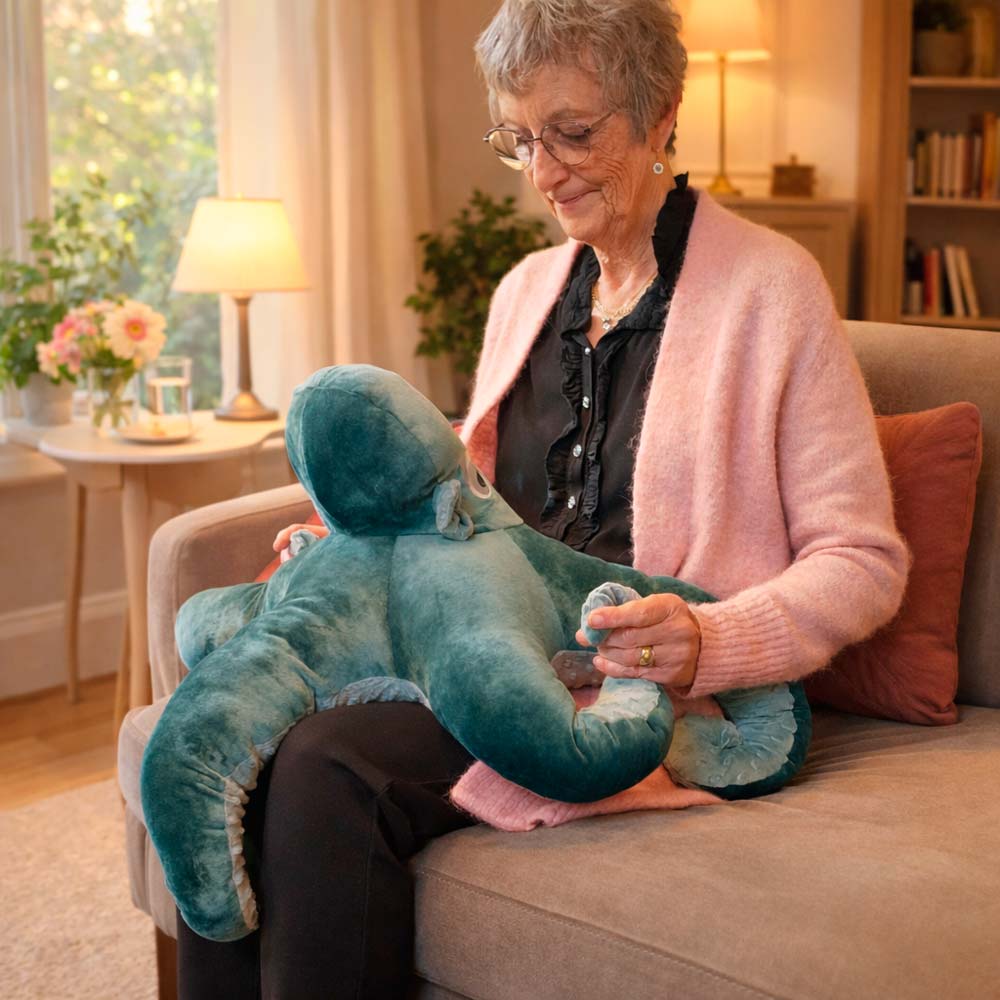
What works for one resident may worsen the situation for another. Therefore, evening routines should not be standardized in detail, although the framework may be common. Some become calm through communal singing. Others need to retreat to their own space. Some settle down by sitting with a pillow over their thighs or with a tactile aid in their hands. Others prefer to hear one quiet voice and very little touch. This differentiated approach is an essential part of the treatment, with the aim of enhancing the well-being of the individual demented resident.
Life history and habits are important clues. If a resident has always drunk tea at eight o’clock, listened to the radio or put their clothes away for the next day, small parts of that rhythm can create an experience of coherence. It is often here that person-centered care becomes truly concrete and the effort in the treatment is adapted to the individual resident’s needs.
A short question in the team can make a big difference: What usually works for this resident when the day gets tough? The answer is rarely the same for two people.
Environment, light and sound are of great importance for evening activities for people with dementia
The evening at a nursing home involves many shifts, which can have an evening shift effect on the residents. Changing shifts, cleaning, medication, personal care, and residents reacting differently to fatigue require a coordinated treatment approach. If the surroundings are also characterized by harsh light, television, restlessness in the hallways, and many short interruptions, the load quickly increases – both for the body and for the brain, which is controlled by countless brain cells.
Daylight rhythm lighting and more conscious use of light are mentioned in several experiences as useful support. In the morning, brighter light can help with orientation and circadian rhythm, while warmer and softer evening lights can signal to the brain that it is time to relax. Even without special lighting solutions, much can be achieved by using table lamps, pulling up the curtains at the right time, and avoiding sharp ceiling lights close to bedtime.
The same applies to the sound environment. A low-spirited department spreads negativity, and an agitated department negatively affects the mood – which in turn challenges the overall care of evening activities for dementia-affected residents.
Sensomotoric aids can support calmness when used professionally.
In some residents, bodily restriction and tactile stimulation be a valuable part of the evening routine. It can be a shoulder cushion, one thigh cushion, one weight blanket, one quiet rocking chair or an tactile aid, That provides hands with something meaningful to be in contact with. The goal is not to “fix” the behavior, but to support the nervous system in calming down as part of the overall treatment, which also benefits the brain and its brain cells.
This type of assistive device should always be chosen based on an individual assessment. The resident’s disease picture, mobility, respiratory conditions, skin condition, and response to touch must be taken into account. Some people experience clear comfort from weight and deep pressure, while others do not – and this highlights the importance of tailored treatment.
In institutions, it is also important that the solutions are robust, easy to clean, and easy to incorporate into daily workflows. Assistive devices work best when staff know when to use them and when not to.
The communication of the staff at evening meetings is often more important than the words.
When a resident is anxious, they do not always understand long explanations. Tone of voice, pace, facial expressions, and distance often mean more than the content itself. A calm voice, few words, and clear physical comfort can mitigate the situation before it grows – and this is a central part of the overall treatment. Many staff members know the experience of a low-pitched song, a slow movement, or a friendly nod being able to change the entire interaction. It is not about “entertaining” the resident, but about lending one’s own calm.
In practice, the following approaches are often helpful:
- Speak slowly: one message at a time and preferably with short sentences
- Use your body calmly: slow down the pace, take breaks, avoid sudden movements
- Make contact first: Say your name, make eye contact, don't stand too close
- Confirm the feeling: Face the uncertainty before you try to change your behavior
- Famous songs
- Warm drink
- Dimmed lighting
- Fewer people in the room
These methods are part of a holistic treatment approach that aims not only to alleviate evening restlessness but also to promote the overall well-being of the elderly residents.
Interdisciplinary collaboration makes the implementation of soothing routines more stable
Even good routines lose their effectiveness if knowledge is lost between shifts. Therefore, many care centers benefit from short triage meetings, boards, or regular reports where the night shift can quickly see who was sleeping poorly, who had pain, and what interventions worked the day before. A consistent treatment of evening dementia care routines depends on close collaboration where all parts of the care support each other.
It doesn’t have to be heavy documentation. A simple common structure is often enough. The crucial thing is that observations are translated into action. If one resident becomes more restless after a stay in the common room, it should be visible to the next shift. If another calms down with singing or a weighted blanket, it should also be clearly visible.
When caregivers, therapists, nurses and management work in the same direction, evening care is not an individual problem for the individual employee. It becomes a shared professional task and part of the ongoing treatment.
This is how the effects of evening routines in dementia can be observed in everyday life
Many interventions are initiated with good intentions, but without anyone really knowing whether they work. That is a shame, because the effectiveness can often be assessed using simple methods. Systematic follow-up of the chosen treatment helps ensure that the calming routines actually strengthen both the residents’ well-being and their overall well-being.
You don't need extensive charts to get started. The most important thing is to record a few things consistently over time. How many episodes of restlessness were observed? When did they occur? What were the tests? What helped? How was the sleep afterwards?
A simple evaluation framework might look like this:
- Choose 1 to 3 residents where evening activities are very important.
- Describe the current pattern for a week.
- Introduce one change at a time – for example, music, lighting adjustment, a dose of light physical activity, or a warm drink – as part of the treatment.
- Follow the development for 2 to 3 weeks and then adjust accordingly.
Small improvements count. Fewer conflicts at bedtime, less yelling, quieter movements, or shorter time to fall asleep are all signs that something is moving in the right direction.
A realistic implementation plan for care centers with a focus on evening care
It is rarely necessary to change the entire shift at once. Often it is better to start small and create a model that employees can stick to. When the routine is simple, it also becomes more robust on busy days – and part of the treatment that supports mental calm in the brain and strengthens brain cells.
Start with one department or one group of residents. Choose a few fixed elements and let them be repeated at the same time every day. This makes it easier both to learn and to assess.
A practical start-up could be:
- Map out the most stressful times between 17:00 and 22:00
- Agreement on 2 to 3 common soothing measures that form part of the overall treatment
- Assign responsibility for handover between guards
- Choose a simple method for registration
- Follow up weekly in the team
As evenings become more predictable, it is often not only the residents who feel it. The staff also benefits from better workflows, more peace of mind in their interactions, and greater certainty about what needs to be done when the turmoil sets in. It is precisely here that the evening routine calming techniques and the continuous care become an essential part of the overall quality of everyday life.
[custom_faq_accordion]
Share this article
Other Articles

October 17, 2026
October 17, 2026

October 17, 2026
October 17, 2026
October 17, 2026